High Strength Steel Guide: From S355 to S960 Grades
In the world of structural engineering, moving beyond standard carbon steel is no longer a luxury—it is a necessity for performance and sustainability. High Strength Steel, or HSS, allows for leaner designs, reduced welding volumes, and significantly lower transportation costs.
However, the naming conventions of European standards often cause confusion on the shop floor. Selecting between an S460MLH and an S460NH is not just about a label; it dictates how your project will be welded, formed, and how it will perform in sub-zero temperatures.
—–Deciphering the Grade Hierarchy——————————
The numeric value in any EN grade, such as 355 or 960, represents the minimum yield strength measured in megapascals. While S355 remains the global workhorse for general construction, the industry is rapidly shifting toward S460 and S690 to meet weight-saving targets.
The Impact of Processing: M, N, and Q
The letter following the strength indicates the delivery condition, which is arguably the most critical factor for fabrication.
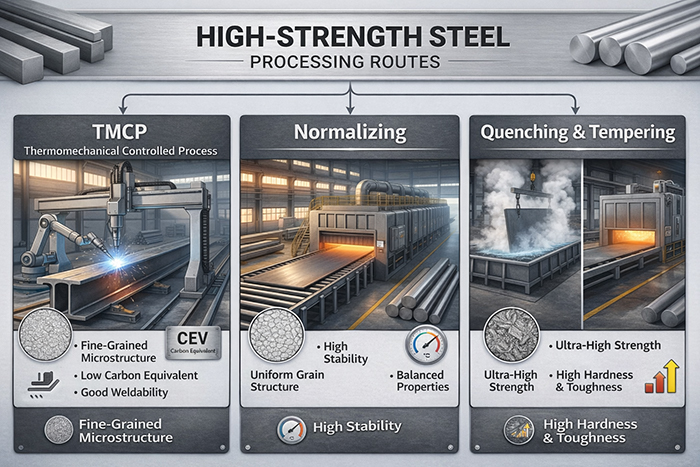
- M-Series (Thermomechanically Rolled): These steels are processed at specific temperature ranges to achieve high strength with very low carbon equivalents. This makes M-series steel exceptionally easy to weld, often removing the need for preheating even in thicker sections.
- N-Series (Normalized): A traditional approach where the steel is heat-treated to achieve a uniform grain structure. It is highly stable and preferred if the steel will undergo further heat treatment or hot forming during production.
- Q-Series (Quenched and Tempered): This is the gold standard for ultra-high strength. By rapidly cooling and then reheating the steel, we achieve yield strengths from 690 MPa up to 960 MPa. However, these grades require strict thermal control during welding to avoid softening the material.
—–The Importance of Low-Temperature Toughness——————————
Strength is only half the story. As steel becomes harder, it naturally becomes more prone to brittle fracture. To counter this, engineers must look for the L or L1 designations.
Standard grades typically guarantee impact energy at -20°C. If your project faces harsher environments—such as offshore platforms, high-altitude equipment, or arctic infrastructure—you must specify MLH or NLH for performance at -40°C, or the elite QL1H for reliability down to -60°C.
Strategic Application of High Strength Stee
|
Strength Tier |
Primary Grades |
Best Use Case |
|
Standard HSS |
S355NH, S355MLH |
Warehouses, simple frames, and static structures. |
|
Performance HSS |
S460NH, S460MLH |
Bridge girders, high-rise columns, and offshore jackets. |
|
Ultra-High HSS |
S690QL1H, S960QL |
Crane booms, telescopic arms, and mining equipment. |
|
Formable HSS |
S700MC |
Truck chassis and complex cold-folded components. |
—–FAQ——————————
Q1:Can I directly replace S355 with S960 to save weight?
A1:Not exactly. While S960 is nearly three times stronger, the elastic modulus of steel remains constant. If your design is limited by “deflection” or “stiffness” rather than “strength,” the thinner S960 section might vibrate or flex too much. You must redesign the geometry to take full advantage of the higher strength.
Q2:Why is S700MC different from S690QH?
A2;Though their strengths are similar, S700MC is designed specifically for cold forming and bending. It is a thermomechanically rolled plate (MC) that can handle tight bend radii without cracking, whereas Q-series steels (QH) are optimized for structural hollow sections and heavy plates where brute load capacity is the priority.
Q3:Does welding affect the strength of S960?
A4:Yes. Ultra-high strength steels rely on precise heat treatment. If the welding “heat input” is too high, it creates a Softening Zone in the area next to the weld. This reduces the local strength of the joint. Welders must follow strict procedures regarding interpass temperatures and cooling rates.
Q4:Is S460MLH easier to weld than S460NH?
A4:Generally, yes. Because MLH grades use thermomechanical rolling, they achieve their strength with fewer alloying elements like carbon and manganese. This lower carbon equivalent makes the steel less prone to hydrogen cracking, often eliminating the requirement for preheating the metal before welding.
Q5:What does the “H” at the end of these grades represent?
A5:The H stands for Hollow Section. Whether the pipe is a circular, square, or rectangular tube, the H suffix confirms that the material meets the specific requirements of the EN 10210 or EN 10219 standards for structural hollow sections.